Learn how oil encapsulation turns sensitive oils into stable beadlets, reducing oxidation and leakage for capsules, tablets, sachets, gummies and powders.
Written By
Aishwarya
Published on
09 October 2026
Tags
Oil-based ingredients add value to nutraceutical formulations but can present several technical challenges when incorporated into the final product. Their sensitivity to environmental conditions, limited compatibility with water-based systems, and physical properties can all affect processing, stability, and the final dosage form.
One big issue is oxidation. Oils high in unsaturated fats e.g., omega-3 oils react with oxygen, heat, light, and moisture, which can accelerate oxidation. Oxidation can cause unpleasant odors, off flavors, and ingredient degradation. Consider all these factors when processing, packaging, and storing.
Another issue is poor water compatibility. Many oils won't mix well with water, making them difficult to incorporate uniformly into water-based products such as drinks and powders. If the formulation isn't right, the oil will tend to separate, distribute poorly, and negatively affect the final product's appearance and texture.
Leakage and handling problems can also occur when oils are used in solid dosage forms. Liquid oils can leak out of position, cause stickiness, or adversely affect powder flow and associated manufacturing operations. This can, in turn, complicate the blending, filling, and manufacture of consistent capsules, tablets, sachets, and powders.
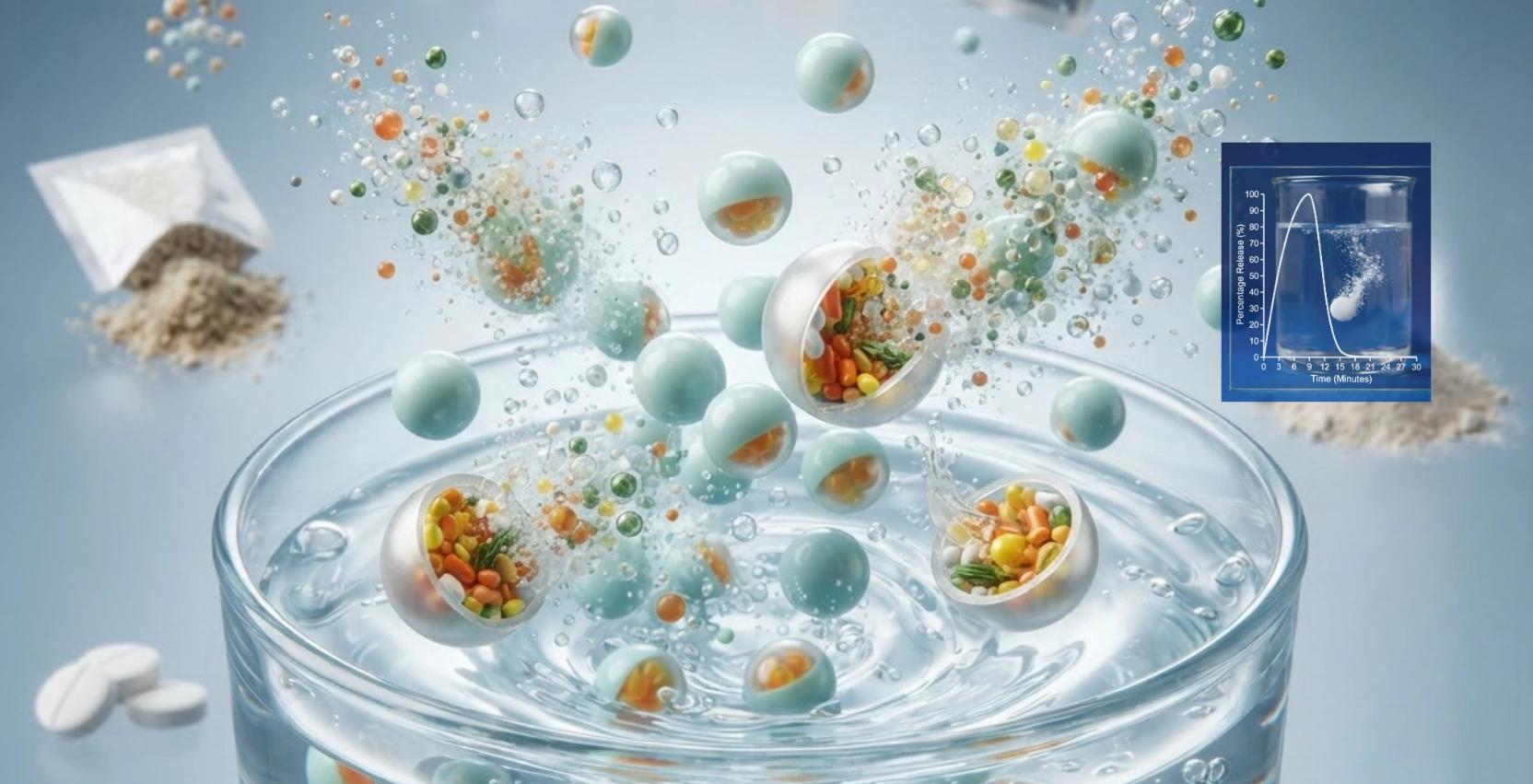
This is where oil encapsulation can be of value as a formulation strategy. You can create encapsulated oil beadlets by incorporating the oil into a suitable carrier system. The encapsulation technique and materials used will determine whether the resulting formulation has improved handling, reduced surface oil, and/or some degree of protection against environmental exposure.
The key is to match the formulation strategy to the oil its nature and sensitivity, the dosage form you're trying to achieve, and the product characteristics you're after. That's the first step in developing nutraceutical formulations that are easier to process, store, and incorporate into the final product.
The next stage is selecting the carrier system. Select the appropriate carrier, matrix, or coating material based on the active's physical properties, compatibility, and intended application. The active may be dispersed throughout a bead matrix, incorporated into a core, or encapsulated in a coating. Each option creates a different particle architecture and serves a specific purpose in the formulation.
Particle engineering then turns the selected ingredients into defined beadlets. The appropriate technique (extrusion-spheronisation, fluid bed layering, etc.) will be used depending on the formulation and the required bead characteristics. The resulting beadlets can be tailored to specific parameters, including size, active loading, and coating thickness.
The beadlets are then assessed for a range of characteristics including size distribution, active content, moisture, surface active content and physical integrity. Further testing may be carried out to determine encapsulation efficiency, stability, dissolution and or release as appropriate to the intended use. This testing is all designed to determine whether the beadlets meet the requirements for inclusion in the final product.
Ultimately, its combining particle engineering with process engineering. The aim is to produce beadlets that provide the required level of ingredient protection, handling characteristics, and compatibility with the final dosage form. By applying the right process to each active ingredient, you can create bespoke encapsulated beadlets to meet a wide variety of nutraceutical formulation requirements.
An encapsulated beads performance depends on the materials its made from. The carrier material, encapsulant, and coating all affect how the active is incorporated, held, and released in the final nutraceutical formulation. The right mix depends on the actives properties and the application.
Carrier materials form the basis of many encapsulation systems. They form the particle structure that incorporates the active and affects bead strength, texture, moisture characteristics, and processing. The carrier also affects how much active can be incorporated while still achieving the required physical properties.
Encapsulation agents will assist in defining the structure that will hold the active. They can form a matrix around the active or contribute to a surrounding layer. The agents compatibility with the active and other formulation components is important for achieving the desired active distribution, retention, and particle integrity. The material system must also be compatible with the processing conditions employed to make the beads.
For particularly sensitive ingredients where environmental exposure is an issue, a protective coating can provide an extra means of formulation control. The right coating can help limit exposure to oxygen, moisture, or other environmental factors. It can also influence bead behavior during storage, processing, or under certain formulation conditions.
Material selection will also affect active loading and ingredient retention. Higher active content will inevitably reduce the proportion of carrier available to support the particle structure, which can affect bead strength, surface active content, and processability. The objective is therefore not simply to maximize loading but to achieve an appropriate balance between active content, physical integrity, and formulation performance.
Ultimately, no single carrier or coating is ideal for every active. Oils, vitamins, minerals, and botanicals all have their own formulation issues. At Umang Nutraceuticals, we can select and formulate the right material and process for the active and application to produce encapsulated beadlets with the characteristics required for the final nutraceutical product.
Many nutraceuticals are sensitive to the conditions they face during manufacture, storage, and handling. Oxygen, light, heat, and moisture can cause chemical changes that affect potency, stability, color, and odor. For a manufacturer working with sensitive oils, vitamins, and botanical actives, mitigating these risks is fundamental to formulation development.
Exposure to O2 can accelerate oxidation (particularly in oils high in unsaturation and other oxidation-sensitive ingredients), potentially causing unpleasant odors, off-flavors, and ingredient degradation. Light can also cause or accelerate the degradation of some sensitive compounds. Excessive heat can increase the rate of some chemical reactions and may damage heat-sensitive actives. Moisture can directly affect some ingredients and can also affect the physical stability of the encapsulating materials.
However, encapsulation alone doesn't guarantee stability.
An encapsulated bead's performance is a function of its size, its structure, and its coating. All of those factors will have an effect on the degree of protection afforded to the ingredient, the handling characteristics of the bead, and how it will perform in the final nutraceutical product.
Bead size affects the flow of the bead, how well it blends with the other materials, and how thick the coating has to be. You choose the appropriate bead size based on the dosage form you want and the requirements of the manufacturing process.
The internal architecture tells you how the active is situated within the bead (either as a core or as a particle). The chosen structure depends on the active's properties, its interaction with other components, and the required level of protection.
Coating composition and thickness will dictate the bead's barrier properties. Keep the bead intact. A good, even coating will, of course, limit environmental exposure. If the coating is too thick, it can change the bead size and cause processing problems.
Good bead engineering is all about matching the bead size, bead structure, and bead coating to the active and its use. The aim is to get the right balance so that the active is protected, the bead is easy to handle, and the formulation is compatible.
Beadlet quality depends on balancing how much active ingredient is added, how much stays inside, and the bead’s physical properties. This balance helps beadlets work well in the final product. The result also depends on the type of active ingredient, carrier materials, and how they are made.
The amount of ingredient you add depends on how easily it dissolves, its thickness, and how well it mixes with the carrier. Adding too much active ingredient can weaken the bead. The formula should balance the amount of active ingredient with the beads strength and ease of production.
Encapsulation efficiency shows how well the active ingredient stays inside the bead. Both the carrier materials and the process affect this. If too much active ingredient is on the surface, it can be exposed to air and water, or make the beads harder to handle and move.
How beads are made, temperature, drying methods, and coatings all affect bead size, internal moisture, strength, and consistency. Quality checks usually measure active-ingredient content, bead size, strength, and stability. You may need more tests depending on the ingredients and how the product will be used.
To keep beads in good condition, you need to balance active-ingredient levels, retention, and physical performance. This requires a well-designed formula and careful process control.
Encapsulating oil into beadlets helps manage oil sensitivity. Quality control does not end at manufacture. Oil can continue to degrade during storage and transport because of exposure to oxygen, heat, light, and moisture. The encapsulation system must match packaging, storage conditions, and stability monitoring.
Packaging is absolutely critical for encapsulated oil. The type of packaging directly affects protection from oxygen, moisture, and light. For some oils and beadlet formulations, high barrier packaging may reduce exposure and slow oxidation. Integrity is key because any seal breach or re exposure to air after opening reduces protection.
Temperature and humidity also affect oil storage stability. High temperatures can accelerate oil oxidation. Drying can affect moisture-sensitive materials and the rheological properties of the beads specifically. In some formulations, moisture uptake can change flowability, cause agglomeration, and reduce particle integrity. Appropriate storage conditions will help maintain the quality of the encapsulated oil.
Moisture control starts at the processing stage. It continues through to storage—final beadlet moisture content, packaging permeability, and the storage environment all affect stability. Drying conditions and packaging will help establish the right moisture balance for the formulation.
Oxidation monitoring will tell you whether the oil is staying in spec over time. The tests you'd use would depend on the oil type. These could include peroxide value and various indicators of secondary oxidation as well as sensory tests (smell and look). Where appropriate, you'd also do content testing to give a more complete picture of the oil's condition and to help identify changes that may not be evident from beadlet-decidability studies under defined storage conditions. They allow the manufacturer to assess the effect of beadlet design, packaging, and recommended storage rather than relying on encapsulation as the sole means of protection.
The science of oil encapsulation goes beyond protecting sensitive oils; it also involves making them suitable for incorporation into different nutraceutical products. Since oils can be prone to oxidation, have poor water compatibility, and present handling challenges, the encapsulation system must be designed around both the properties of the oil and the requirements of the final formulation.
In capsules and tablets, encapsulated oil beadlets can offer a convenient solid format for incorporating oils into dosage forms. For sachets and powdered supplements, factors such as dispersibility, particle size, and blend uniformity become important. In gummies, the beadlets must be compatible with the gummy base and its processing conditions while maintaining the desired product characteristics.
The selection of carrier materials, encapsulation technique, oil loading, and protective matrix influences the properties of the resulting beadlets. These factors must be evaluated according to the oil being encapsulated and the intended application, as a formulation suitable for one supplement format may require adjustments for another.
Ultimately, successful oil encapsulation is not simply about converting liquid oils into solid beadlets; it is about developing a stable, manageable format that meets the needs of the finished supplement. By aligning oil characteristics, encapsulation design, and dosage-form requirements, manufacturers can explore customized oil-based beadlets for capsules, tablets, sachets, gummies, and powdered nutritional products.
Aishwarya
09 August 2026
Discover how immediate-release beadlets improve nutraceutical formulations with rapid ingredient availability, better handling, taste masking, stability, and flexibility.
Read More →

Aishwarya
29 August 2026
Discover how lipid-coated beadlets improve nutraceutical formulations by protecting sensitive ingredients, enhancing handling, masking taste, and controlling release.
Read More →

Aishwarya
06 August 2026
Discover how encapsulated beadlets improve gummy formulations by enhancing ingredient stability, masking taste, extending shelf life, and protecting sensitive actives.
Read More →

Aishwarya
03 September 2026
Discover how encapsulation transforms challenging nutraceutical ingredients into stable, formulation-ready ingredients for innovative supplement products.
Read More →
Aishwarya
07 August 2026
Discover how encapsulated amino acids improve sports nutrition formulations with better taste masking, enhanced stability, ingredient compatibility, and versatile applications.
Read More →

Aishwarya
09 October 2026
Learn how oil encapsulation turns sensitive oils into stable beadlets, reducing oxidation and leakage for capsules, tablets, sachets, gummies and powders.
Read More →

INDIA - CORPORATE OFFICE
Unit No. 1, 2nd Floor, Vicino (Mega Mall), New Link Rd, Oshiwara, Andheri West, Mumbai, Maharashtra, India. 400102
MANUFACTURING FACILITY
Unit No. 1, Survey No. 52/2, NH8, Shirsad, Vajreshwari Road, Opp. Mandvi Police Station, Village - Mandvi, Taluka- Vasai, District- Palghar 401 303, India.